Everything They Didn't Tell Me
1 October – 19 November 2026 · dodomugallery.com
I paint the conversations that society quietly ignores.
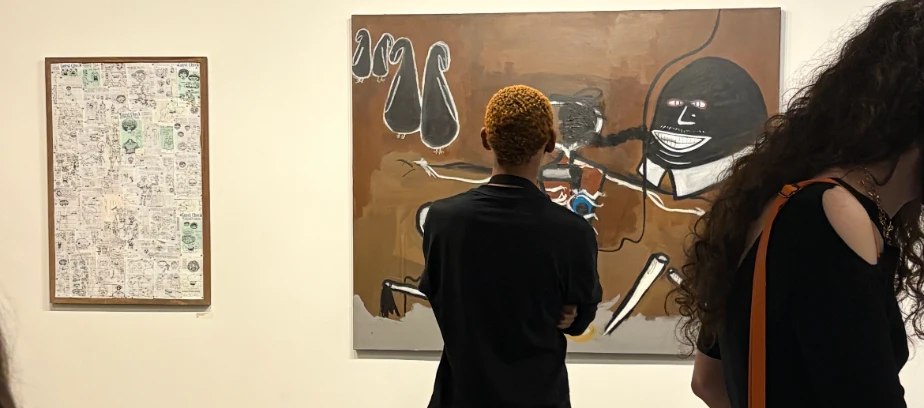
The faces fragment because the people inside them are made to carry two readings at once: gentle, hardworking, a father — and in the same breath a killer, an animal, something to be afraid of. The visible seams are that contradiction, held in one head. I don’t paint faces; I cast parts.
Everything They Didn't Tell Me began with a title that arrived before the paintings — a phrase for what nobody had passed down. The series is ten paintings in four acts: Micro, Collision, Macro, Wisdom. They move from the interior — psychological, personal — outward to the systemic: labor, entertainment, environment, and what a culture does to the people it needs.
Every canvas begins on a yellow-ochre ground. It is the color the European tradition called “flesh,” as if one skin were the default — a color you could buy in a box under that name until 1962. The whole surface is that assumption before a single figure exists, and the figure is built on top of it. The ground is not background. It is the argument the painting is answering.
I came to painting from theatre, which I studied at Columbia College Chicago, and from years of working as a musician. I am self-taught as a painter, and I still build a picture like a scene — every figure is doing two things at once. Oil stick sits on top of the acrylic and stays a gesture, closer to annotation than to paint: marking up a record somebody else printed.
These are think pieces. Mental dens. They are built to make someone ask whether what they know is the truth, or whether they have been lied to their whole life — the kind of conversation you start in front of the people whose opinion you care about, because everyone is standing in their own bubble.
I went and found what I wasn't given. The work hands it back — as wisdom rather than comfort.
Stretched cotton canvas, unframed. Nine works run between 36 × 48 and 48 × 60 inches; the tenth is 36 × 24. Dead Riding Dead was made from a service receipt at the shop where I work — the list of customers due to arrive that day, handed to me at the start of every shift. The receipt is not in the painting and its contents are not reproduced.
Gesso, then a yellow-ochre field laid across the entire surface before a single figure exists. The figure is built on top of that assumption rather than around it.
Acrylic, in layers, working forward from the ground. The figure goes on last.
Applied over the acrylic, never beneath it. It stays a gesture rather than becoming paint — closer to annotation than to rendering, marking up a record somebody else printed.
Painted. Nothing here is collaged, cut, adhered or assembled, and there is no encaustic. The seams that look cut are made with a brush, and that distinction is the subject rather than the technique.
Drawn in 2024. Painted in 2026.
The Ten Works
Four acts, read in sequence — from the interior outward to the systemic. Select any work to view it enlarged.
See all exhibitions and installation views →